Wednesday, 25 June 2014

The Hackgate Scandal

Your task today is to produce a briefing on one of the recent major media/politics stories:
(1) the so-called 'Hackgate' scandal that has lead to the convictions of some prominent media figures, and difficult questions being asked of the Prime Minister, David Cameron

We'll watch the short Newsround report on the Hackgate trial


You/your group will get a stamp for every informative section you include on elements such as...
You can easily find informtaion with searches including some of the following:
Hackgate, phone hacking, News International, News of the World closure, Milly Dowler hacking, Hacked Off Hugh Grant, News International court case, Rebecca Brooks Andy Coulson trial, Rupert Murdoch hacking questions (etc)

Some sample links are contained in the list above, but here are a few more:
the Wiki;
BBC timeline (up to 2012);
CNN facts guide;
Guardian newspaper articles on phone hacking;
the prosecution case (BBC summary);
the main players (BBC guide);
2014 who's who (updated BBC guide).

Tuesday, 6 May 2014

Facts and figures on UK population

Some links to help you better explore this:
Government's Office of National Statistics (ONS) report that 1 in 8 of UK population were born abroad.
More ONS links.
Guardian table with ethnic breakdown for each council area in Eng + Wales.
Wiki figures for UK and Eng + Wales.
Bar charts showing ehtnic breakdown.
One of the data charts in the Oxford Uni source.
Oxford Uni tables and pie charts (scroll down for pie chart, Figure 2, see the screenshot in this post).

Thursday, 1 May 2014

MPs getting rowdy in the Commons

An example of the (Deputy) Speaker trying to assert control over a rowdy House of Commons:

The rules on the behaviour of MPs are rather strict - when speaking in the House of Commons you are not permitted to accuse another MP of lying, no matter how strong the evidence may be. That would be 'unparliamentary language'.

MPs can be ejected from the Commons chamber for breaking the rules, and this has happened to the likes of George Galloway and Ian Paisley over the years. In most cases 'the Speaker' will intervene, an MP who doesn't take part in votes and basically puts aside his/her loyalty to their own party to see that the Commons runs smoothly: they decide who gets to speak, in what order, for how long, whether they have broken any rules, and oversees the scheduling of debates - which bills get a chance of a first/second/third reading.

Here's an example of an MP doing what 'Tarzan' (the nickname given to Tory MP, later a powerful government minister, Michael Heseltine) did back in 1976 - swinging the mace that lies between the two front benches.

By the way, did you know that the gap between the benches is measured in sword lengths, to avoid conflict?!
Below the line: several videos showing MPs misbehaving!

Monday, 31 March 2014

Darth Vader for President?

This brings to mind the growing protest over the census form (every 10 years the government sends out compulsory forms to track the demographics of the UK, including sections for religion) which has seen 'Jedi' become the 4th biggest 'religion' in the UK, rivalled by The Flying Spaghetti Monster. We also have the Pirate Party in the UK, dedicated to overturning digital copyright laws.
At the very end of the article, there is a sense of some seious politics amidst the theatrics:
The UIP was registered in 2010 and aims to create an electronic government in Ukraine, transition to digital media and offer free computer courses to all citizens.
Read the full article here.

Thursday, 27 March 2014

Would e-voting encourage the young to vote?

In the light of the March 2014 budget, I recently blogged on the potential impact of pensions reforms - something that a typical young person is highly unlikely to have ever thought about - on the lifetime earnings and tax deductions faced by the young generation whose wages (through income tax) are going to pay for this.
KEY STAT: 76% of pensioners vote, only 44% of under-25s vote
I mentioned the common analysis that this reform, brought in by the Conservative and Lib Dem coalition BUT eventually backed by Labour too, reflected the much higher priority the main parties give to older voters because they are so much more likely to actually cast their vote than the young. The 'grey vote' was a much used term.

Now comes news that the organisation which advises the government on how well or otherwise our democracy's voting system is functioning, the Electoral Commission, has also stated that we need reforms to close this growing voting gap between young and old: 76% v 44% respectively.

Here's the Guardian article in full:
The UK should consider allowing internet voting in elections because the current system risks appearing alien and outdated to an increasingly disenfranchised younger generation, the election watchdog has said.
Launching a review of modern voting, the head of the Electoral Commission, Jenny Watson, warned that the state of the electoral system was "not an issue that can stay on the slow track any longer".The long-term trend of falling voter turnout was particularly marked among young people, she said.
Watson said the election watchdog would examine a range of ways to make voting more accessible, including the "radical" option of internet voting and US-style same-day registration for those not on the electoral roll.
"Whether it is the ability to register to vote on the day of the election, or voters being able to use any polling station in their constituency, or the introduction of advance voting, or even more radical options such as e-voting, we plan to look at a variety of options, assessing how they will help citizens engage more effectively," she said.
Watson said online registration was welcome but did not add up to an ambitious, comprehensive modernisation strategy.
With some polls showing 76% of pensioners voting compared with 44% of eligible under-25s, the Electoral Commission said more could be done to make the system more reflective of wider society.
"By doing so we could by proxy help address some of the issues with turnout, particular amongst an increasingly disenfranchised younger generation," Watson said. "Unless our electoral system keeps pace with the way many voters live the rest of their lives – where the way they bank and the way they shop has been transformed – it risks being seen as increasingly alien and outdated, particularly to young voters as they use it for the first time."
She said critics should not see change as a move towards making the electoral system like The X Factor, as society must make sure voting was seen as a "serious and important civic act".
A Cabinet Office spokesman said: "The government is always looking at how our electoral system can modernise – that's why we are bringing in online registration and introducing individual electoral registration this summer.
"Technology changes fast and there is always more that can be done to make voting accessible, but it is the government's primary concern to ensure the effective delivery of elections."
What do you think? Would YOU be more likely to vote if you could do it online? Remember, 16 year-olds have been given the right to vote in the Scottish referendum in 2015, and one of the big three parties (Labour) has said it would look at extending this for general elections too, so the issue of voting might not be so distant after all...

Thursday, 20 March 2014

2014 Government Budget: Taxing Your Future?

Helpful starting points/further reading: BBC Beginner's Guide to the Budget
The Gov.UK guide to government spending is more technical 
My previous blog post has many graphics, links and a short video

An unfortunate comparison, but this useful guide gives a quick summary of local gov. spending on p.12; I've also blogged on this before with many more resources!
older people vote – 76% last time. What is the point of easing the housing, jobs and debt crises of the young when only 44% bothered to vote? Low

earners don't vote much either, so the young/poor vote least of all. The IPPR shows how, since 2010, average voters lost 12% in service cuts, but those who didn't vote lost 20%, or £2,135 a year. So, Russell Brand, young people are badly treated if they don't vote. [Polly Toynbee, Guardian, 21.3.14 - lots of facts and figures on how decisions by both major major parties in recent years have hit young people]
Toynbee, above, criticises Brand; videos on Brand's controversial views here.

This can seem very abstract, and alien to teenagers who might not think this impacts upon them, but government budgets, and so their public spending plans, include how much more or less they will spend on schools for example, and how this money is divided up.

This Guardian article claimed that the budget targeted pensioners votes
There is an increasingly common point of view that this government - like its predecessors - puts the interests of pensioners above those of young people, basically because they are much more likely to vote. All of the broadsheet or 'quality' papers from March 20th 2014 (except the Telegraph) specifically mention the 'grey vote' on their front pages. We'll explore the press in more detail in another lesson.

Read what press expert Roy Greenslade made of the press coverage here.
 ..............................................................................................


If you skip to 2:12 in, this BBC radio guide to the economy and public spending explains how it works if we imagine that the whole UK economy amounted to just 100 pennies ... from which more and more is going towards paying out pensions, putting pressure on spending on other areas, such as education.
Skip to 2:13 in, and this is a very user-friendly guide!
The Guardian reports that the 2014 budget, from 19th March 2014, was quite obviously pro-pensioner and unfavourable to youth (or 'Generation Y'), as the sample quote below illustrates:
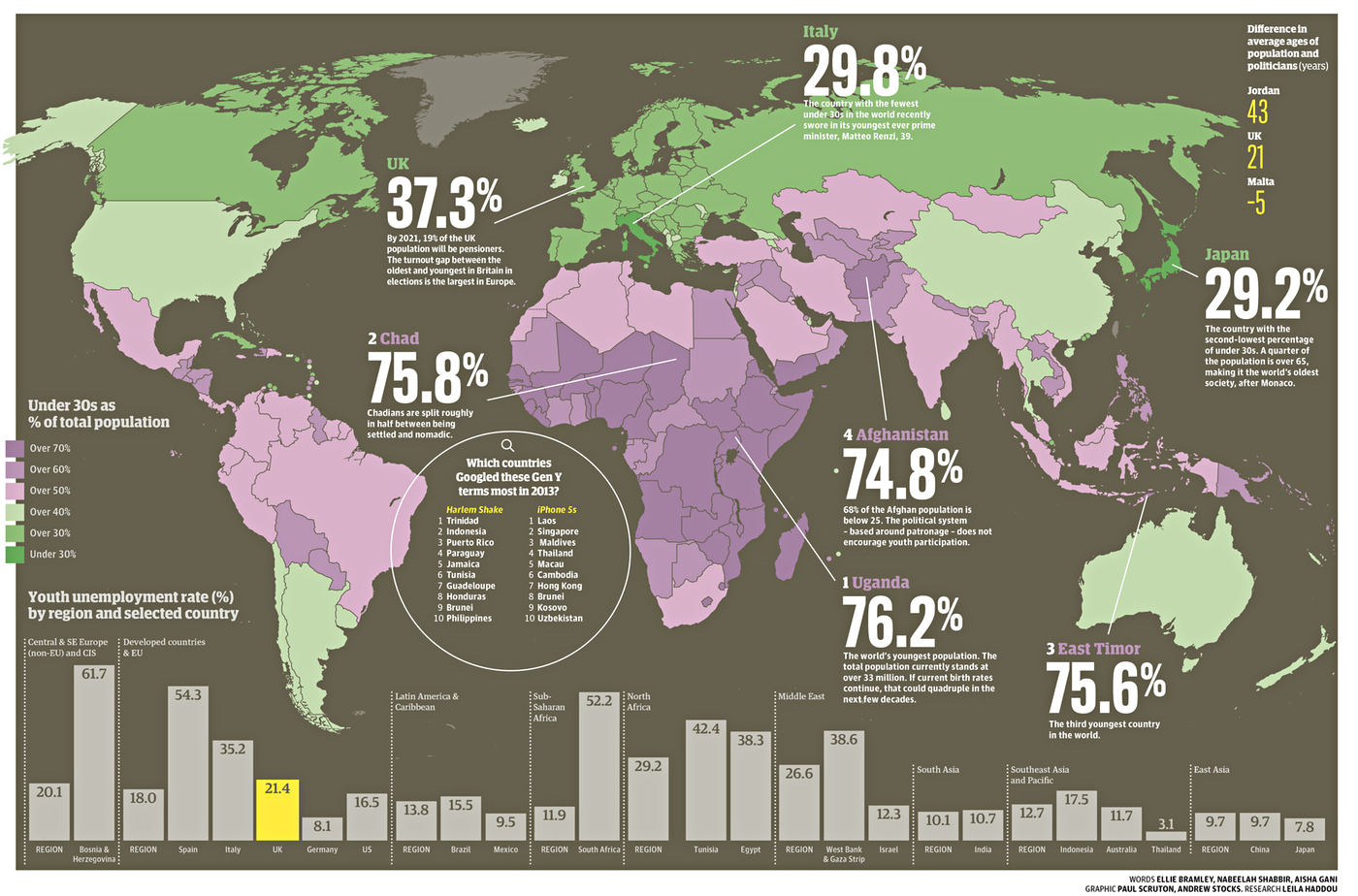
It can be useful to have a grasp of the demographics of the UK; the map below (click here for the full-size image, here to read analysis of how the size of a youth population influences a country's politics) puts the UK into global context:
There are lots of reports on this year's budget; for example, you can find a 100 second video summary here from the Daily Telegraph, a right-wing paper, or select from a range of articles here from The Guardian, a more left-wing paper.

TASK RESOURCES:
As well as any of the above, you will have the following main resources to use for this task:

Interactive Telegraph guide to public spending - you can click (or just hover) on any of the circles, or the Department names, for further details.

Guardian pie chart graphic of public spending.

This UKPublicSpending.co.uk guide is not so user-friendly, but allows you to access some more detailed breakdowns.

This Money.co.uk guide to the main elements of the 2013 spending review highlights some of the key trends in government spending.

NB: the images below are only screenshots: click on the blue, bold underlined hyperlinks above to visit these sites/resources!
Telegraph guide: click/hover on bubbles or Department names for more detail

Guardian guide; zoom in to read the fine print!

The UKPublicSpending.co.uk guide: click on the + for more details
Money.co.uk guide - welfare is a key target for cuts; what is your view?

Monday, 17 March 2014

UK Political Parties: a guide

The Wiki list
Most of you will know the names of the 3 biggest UK political parties, 2 of which are in government currently as a coalition while the other forms the main Opposition (their job is to respond to government proposals, although they will sometimes agree with these!).

There are many more, from small fringe parties or single-issue parties (UKIP being a good example) to parties which operate only in Scotland, Wales or Northern Ireland, but still send MPs to Westminster plus the devolved parliaments/assemblies of NI/Scotland/Wales.
This link (see screensot, left) contains a list of many of these, including parties which are exclusive to some parts of the UK.
We will spend more time later looking at and comparing the parties policies, but for now you could use this website to compare the policies of some parties (from the last general election):
PocketPolitics guide. (you'd select the 2010 Westminster option)
Here's another lnk, whch looks only at the 3 main parties:
Here's a comparison of the policies of the 3 biggest UK parties, from C4's website. [on a PC CTRL-click links to open in a new tab, on iPad hold the link and select Open In New Tab, so you can keep this webpage open]

If you come across any useful websites/links on UK political parties, pass on details as a comment below and I'll add them to this post


You can use other posts and resources in this blog to help with ideas for your party, and we will return to this frequently. Use the links list you see on the right in the picture below (the post pictured has examples of posters from UK political parties)