This is from a FairTrade campaign from a few years ago - you can see a wide range of other short films/videos produced by FT by clicking here.
(view on Vimeo if you want to avoid ads)
Monday, 25 March 2013

Thursday, 7 March 2013
Twitter and the long arm of the law
 Few people seem to realise they can be fined or jailed for the content of their tweets...
A student who racially abused footballer Fabrice Muamba received a 56 day sentence in March 2012 …
lThe same month as a law student was given 2 years community service after pleading guilty to racially abusing ex-footballer Stan Collymore on Twitter.
lKuwait jailed a citizen in January 2013 for tweeting an insult about the emirLord McAlpine is suing 500 Twitter users for tweeting he was a paedophile (he's offering to let users with less than 500 followers off if they donate £25 to Children in Need). He's suing Sally Bercow for £50,000 damages
See David Conn's analysis of an official report into the racism and other abuse footballers and clubs have received on Twitter and other social media.
lThe Attorney General is seeking fines or imprisonment for the Twitter (and Facebook) users who posted pictures of Jamie Bulger, in contempt of court proceedings. Google, Facebook + Twitter were all ordered to remove the pictures.
Another tweeter was arrested in July 2012 for messages about Tom Daley's late father.
Back in August 2012 The Guardian published a list of 10 ways in which Twitter users could find themselves in court.
 The case that perhaps best demonstrates how far the police are prepared to get involved over tweets concerns a joke, but was no laughing matter for the tweeter involved, who was found guilty and faced jail after 3 trials, but finally won his freedom after his third appeal succeeded at the High Court and his conviction was quashed.
Here's some resources to help you explore this case, gather 5 key facts, and 5 specific arguments for and/or against his conviction:
Lets start with the Wiki on the case!
Here's an editorial from The Guardian on the case;
(Now former) Tory MP Louise Mensch condemns the prosecution;
More reaction to the ruling;
After the publicity the case recieved, the legal guidelines on when to prosecute social media users was altered to prevent unnecessary prosecutions in future - here's a BBC summary.
There are yet more Guardian articles here, or simply try googling 'twitter joke trial' with additional search terms.
Tuesday, 22 January 2013
Media and the law
There are various key resources we will use for this:
Wikis on the Press Complaints Commission and libel/slander; the Press Complaints Commission's own website; Media Guardian articles on media law; my blog on Media Regulation.
Lets start by pinning down the difference between libel and slander:
Lets check out today's front pages: thepaperboy.com
Do you think these papers serve our democratic need to be well informed citizens? What sort of content is featured as headline 'news'?
Wikis on the Press Complaints Commission and libel/slander; the Press Complaints Commission's own website; Media Guardian articles on media law; my blog on Media Regulation.
Lets start by pinning down the difference between libel and slander:
"Defamation" is the general term used internationally, and is used in this article where it is not necessary to distinguish between "slander" and "libel". Libel and slander both require publication. The fundamental distinction between libel and slander lies solely in the form in which the defamatory matter is published. If the offending material is published in some fleeting form, as by spoken words or sounds, sign language, gestures and the like, then this is slander. [SOURCE]
Lets check out today's front pages: thepaperboy.com
Do you think these papers serve our democratic need to be well informed citizens? What sort of content is featured as headline 'news'?
Thursday, 17 January 2013
Budget, Revenue and Spending
The money raised by the government through taxation, assets and borrowing is its revenue, whereas the money paid out is known as government spending. We are currently experiencing widespread government spending cuts. Your generation could grow up with austerity the defining approach to government finance.
Every year the Chancellor of the Exchequer, second only to the Prime Minister in terms of seniority and authority within the government (and many would argue that Gordon Brown was more powerful as Tony Blair's Chancellor than when he became PM himself), sets out the government spending plans, including any changes to revenue-raising (taxes etc), in the Budget.
Every budget has winners and losers. In theory at least, Labour governments (at least before Tony Blair) would set budgets that reduced tax on the poor whilst increasing spending on the poor, using increased corporation (business) and wealth (income) tax to pay for this, while the Tories would cut public spending overall, especially welfare payments to the poor, and focus on reducing tax on the rich and business. The 2012 budget was extremely controversial: the so-called pasty tax (here's the BBC's take) seemed to penalise the poor while the richest saw their income tax cut from 50% to 45%.
After every budget the media quickly calculates who they think will the winners and losers, as do think tanks such as the IFS. The Guardian analyse the 2012 winners and losers from the autumn 2012 statement, which was heavy on welfare cuts, here.
TASK 1: LIST FORMS OF TAXATION
This is a very simple task that you can achieve by quickly browsing the relevant Wikis, hyperlinked above, and looking for the different forms of taxation they list. You should be able to find at least 9. They don't list Council Tax as they focus on national taxation. Write or type these 9, + Council Tax.
Every year the Chancellor of the Exchequer, second only to the Prime Minister in terms of seniority and authority within the government (and many would argue that Gordon Brown was more powerful as Tony Blair's Chancellor than when he became PM himself), sets out the government spending plans, including any changes to revenue-raising (taxes etc), in the Budget.
The Budget is the single most important economic and financial statement made each year by the Chancellor of the Exchequer to Parliament and the nation. The Budget Responsibility and National Audit Act 2011 require the Government to produce a Budget Report for each financial year. The Charter for Budget Responsibility sets out what the Budget Report must cover. [source: http://www.hm-treasury.gov.uk/budget.htm]Here's a short history of the Budget:
Every budget has winners and losers. In theory at least, Labour governments (at least before Tony Blair) would set budgets that reduced tax on the poor whilst increasing spending on the poor, using increased corporation (business) and wealth (income) tax to pay for this, while the Tories would cut public spending overall, especially welfare payments to the poor, and focus on reducing tax on the rich and business. The 2012 budget was extremely controversial: the so-called pasty tax (here's the BBC's take) seemed to penalise the poor while the richest saw their income tax cut from 50% to 45%.
After every budget the media quickly calculates who they think will the winners and losers, as do think tanks such as the IFS. The Guardian analyse the 2012 winners and losers from the autumn 2012 statement, which was heavy on welfare cuts, here.
TASK 1: LIST FORMS OF TAXATION
This is a very simple task that you can achieve by quickly browsing the relevant Wikis, hyperlinked above, and looking for the different forms of taxation they list. You should be able to find at least 9. They don't list Council Tax as they focus on national taxation. Write or type these 9, + Council Tax.
The Wiki on public finance is full of useful facts, including the range of taxes the government uses to raise revenue. There is also a separate Wiki on taxation.
Tuesday, 16 October 2012
Yr11: L1 Recap + Creating Quiz
In this lesson you will:
TASK ONE: 6 GROUPS TACKLE 4 QUESTIONS EACH FROM THE QUIZ SHEET
- familiarise yourself with the resources offered on this blog!
- look back at some of the key terms and concepts you learned last year
- research an area arising from this and...
- create a '3 facts 3 questions 3 sources' briefing/quiz for the rest of the class
TASK ONE: 6 GROUPS TACKLE 4 QUESTIONS EACH FROM THE QUIZ SHEET
Tuesday, 9 October 2012
Yr11 L5: Free speech + web (in)accuracy
See David Conn's analysis of an official report into the racism and other abuse footballers and clubs have received on Twitter and other social media.
Throughout this lesson we will explore and discuss the proposition that:
L5 Free Speech Web Tasksheet
TASK ONE:
State whether you agree or disagree with the quote above, and write down one argument in favour of this AND one argument against.
FEEDBACK: We will take an initial vote on this and come back to it for a second vote by the end of the lesson.
We will also note down some of your initial points for and against the proposition.
TASK TWO:
Click on one or more (ctrl+click to open in a new window or tab so you don't have to re-find this web page!) of the hyperlinks below and make brief notes on a recent case where the limits of free speech online have been tested.
WIKILEAKS accused of endangering soldiers' lives and national security: BBC article; Wikipedia entry; Daily Telegraph on Bradley Manning trial; Washington Post on threat from Wikileaks; has Wikileaks damaged Freedom of Information in the USA?; FreeBradleyManning.org on the question of whether his leaking endangered lives.
TOM DALEY - arrests over abusive tweets (D. Mail); controversial right-wing columnist Melanie Phillips argues this is censorship.
JAILED FOR REVEALING RAPE VICTIM'S IDENTITY ONLINE - Independent reports two charged over tweets in footballer rape case; Mirror report.
Throughout this lesson we will explore and discuss the proposition that:
"People should be free to put whatever they want on the internet"Download, save and use the Word document below (its also in the Citizenship/Yr11 folder, so you can also copy/paste into your My Documents). Type (or print + write) into this as we go.
L5 Free Speech Web Tasksheet
TASK ONE:
State whether you agree or disagree with the quote above, and write down one argument in favour of this AND one argument against.
FEEDBACK: We will take an initial vote on this and come back to it for a second vote by the end of the lesson.
We will also note down some of your initial points for and against the proposition.
 |
| A tweet claiming Wikileaks endangered lives |
Click on one or more (ctrl+click to open in a new window or tab so you don't have to re-find this web page!) of the hyperlinks below and make brief notes on a recent case where the limits of free speech online have been tested.
WIKILEAKS accused of endangering soldiers' lives and national security: BBC article; Wikipedia entry; Daily Telegraph on Bradley Manning trial; Washington Post on threat from Wikileaks; has Wikileaks damaged Freedom of Information in the USA?; FreeBradleyManning.org on the question of whether his leaking endangered lives.
TOM DALEY - arrests over abusive tweets (D. Mail); controversial right-wing columnist Melanie Phillips argues this is censorship.
JAILED FOR REVEALING RAPE VICTIM'S IDENTITY ONLINE - Independent reports two charged over tweets in footballer rape case; Mirror report.
Tuesday, 2 October 2012
Yr11: News v Views + your TV consumption
I'll add video clips used later.
Below you can find two news articles on the news story that will lead your new TV show aimed at 14-19s. One is from The Guardian, a fairly left-wing newspaper (which therefore favours higher taxation and public spending, and is generally pro-unions and positive towards public sector workers, and traditionally very anti-Conservative Party), and one from the very right-wing newspaper Daily Mail (which therefore favours lower taxation + public spending, and is generally hostile towards unions and public sector workers, and traditionally very pro-Conservative Party).
SOURCE 1: http://www.guardian.co.uk/education/2012/sep/30/new-schools-smaller-coalition-budget?newsfeed=true
Below you can find two news articles on the news story that will lead your new TV show aimed at 14-19s. One is from The Guardian, a fairly left-wing newspaper (which therefore favours higher taxation and public spending, and is generally pro-unions and positive towards public sector workers, and traditionally very anti-Conservative Party), and one from the very right-wing newspaper Daily Mail (which therefore favours lower taxation + public spending, and is generally hostile towards unions and public sector workers, and traditionally very pro-Conservative Party).
SOURCE 1: http://www.guardian.co.uk/education/2012/sep/30/new-schools-smaller-coalition-budget?newsfeed=true
New schools to be smaller after coalition cuts building budget
Corridors, assembly halls and canteens to shrink in size under government proposals for 261 replacement buildings
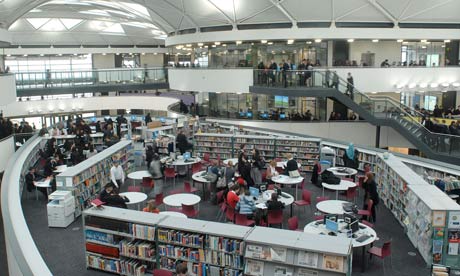 |
The Thomas Deacon
Academy in Peterborough, designed by Lord Foster at a cost said to be
close to £50m |
Subscribe to:
Posts (Atom)